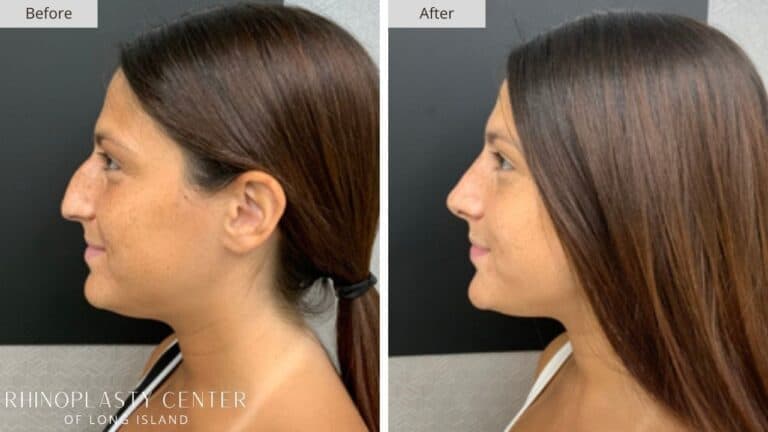
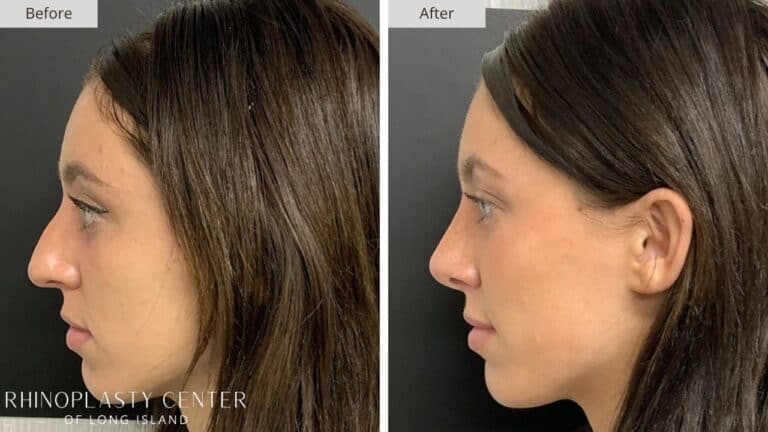
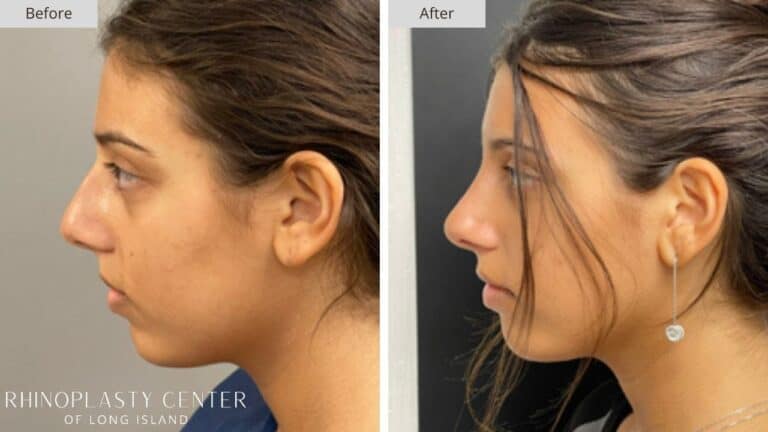
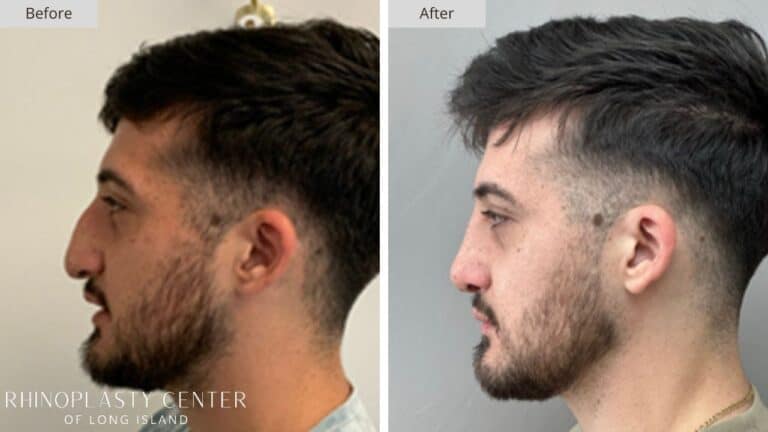
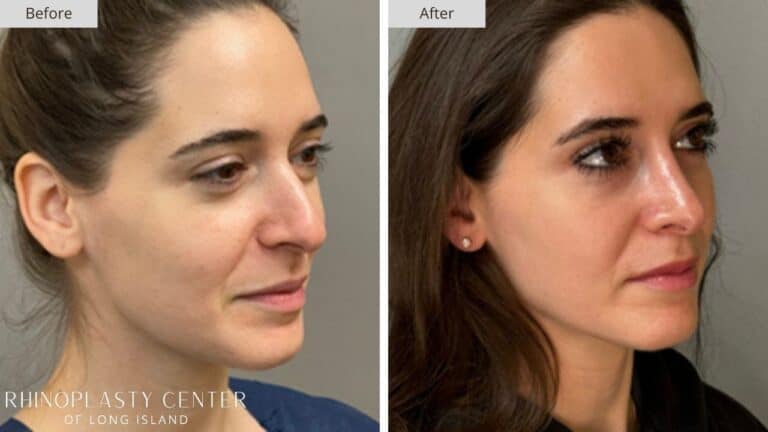
The direction a nasal tip points changes the entire character of a profile. This patient’s case shows that clearly. Her nose type included a dorsal hump, a prominent bridge, and a tip that pointed downward rather than sitting neutral or slightly upturned. That downward direction was the detail our surgical plan centered on.
Why Tip Direction Changes a Whole Profile
A nasal tip that droops downward pulls the entire lower half of the nose along with it. This creates a heavier look across the profile, since the eye follows the line of the tip down toward the mouth instead of along a smooth, forward-facing slope. This patient’s before photo shows this pattern. The tip pointed down, and combined with the prominent bridge above it, the nose read as the dominant feature on her face.
Since tip direction affects the whole profile so strongly, correcting it required more than a small trim. Our surgeon needed to physically change the angle at which the tip sits relative to the rest of the nose. This is a different kind of correction than hump reduction alone, since it involves the supporting cartilage structure rather than just the bridge.
What Tip Rotation Involves
Tip rotation adjusts the angle between the tip of the nose and the upper lip. When a tip points down, that angle is smaller than it would be on a neutral or upturned nose. Our surgeon rotated this patient’s tip upward, widening that angle so the tip no longer pointed downward.
This step involves reshaping the cartilage that supports the tip and repositioning it at a new angle. It is more technically demanding than reducing a hump, since the goal is not to remove material but to change direction while keeping the tip properly supported. Our surgeon rotated the tip enough to correct the downward-pointing appearance without overcorrecting into an unnatural upturned look.
Removing the Hump and Narrowing the Tip Together
Alongside the tip rotation, we removed this patient’s bridge hump and narrowed the tip itself. These three changes needed to happen together rather than one at a time, since each affects how the others read on the finished profile. A rotated tip paired with an unchanged hump would still look unbalanced, since the bridge would remain the more prominent feature.
Narrowing the tip added a final layer of refinement. This patient’s original tip carried enough width that even after rotation, it would have looked broad against a newly reduced bridge. Our surgeon narrowed the tip’s cartilage structure so it would match the more streamlined profile created by the hump removal.
How These Three Changes Work as One Plan
This patient’s case is a good example of why rhinoplasty planning rarely focuses on just one structural issue. The hump, the tip direction, and the tip width all interacted with each other in her original nose. Correcting only the hump would have left a droopy, wide tip on a straighter bridge. Correcting only the tip would have left a hump disrupting the profile above it.
Our surgeon planned all three corrections as one connected procedure, since the final result depends on how the bridge and tip relate to each other after surgery, not on how each looks in isolation.
What the Photos Show
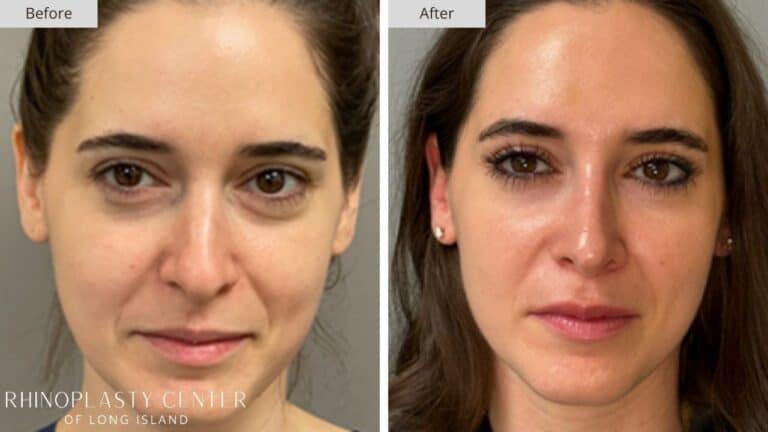
The side profile shows the full extent of this change. This patient’s before photo shows a tip pointing down and a bridge projecting outward above it. The after photo shows a tip that faces forward, rotated into a neutral position, sitting beneath a bridge that no longer carries a hump.
The front view photos add another dimension to this result. They show a narrower tip that reads as more refined and proportional to the rest of her face, alongside a profile that now presents as balanced and refreshed rather than heavy.
The Result
This lift, combined with narrowing the tip, creates a much more balanced and refreshed profile. The tip no longer points downward, the bridge no longer projects past the surrounding profile line, and the nose as a whole supports rather than dominates the rest of the face.
Curious What’s Possible for Your Profile?
If a downward-pointing tip or a prominent bridge is giving your nose a heavier look than you want, a customized plan that addresses both together can restore real balance.
Contact Rhinoplasty Center of Long Island to schedule a consultation and find out what your results could look like.